
CAMPUS: TAMIU installs mulch across campus grounds in new beautification efforts
By Sean Jimenez
Associate Editor
Published Tuesday, March 17, 2026
Ten months after the campus artificial turf installation, Texas A&M International University added a new element to its beautification efforts: mulch.
The new black-dyed mulch replaced previously natural grass patches that were not replaced with artificial turf last year, further reducing TAMIU’s amount of natural grass.
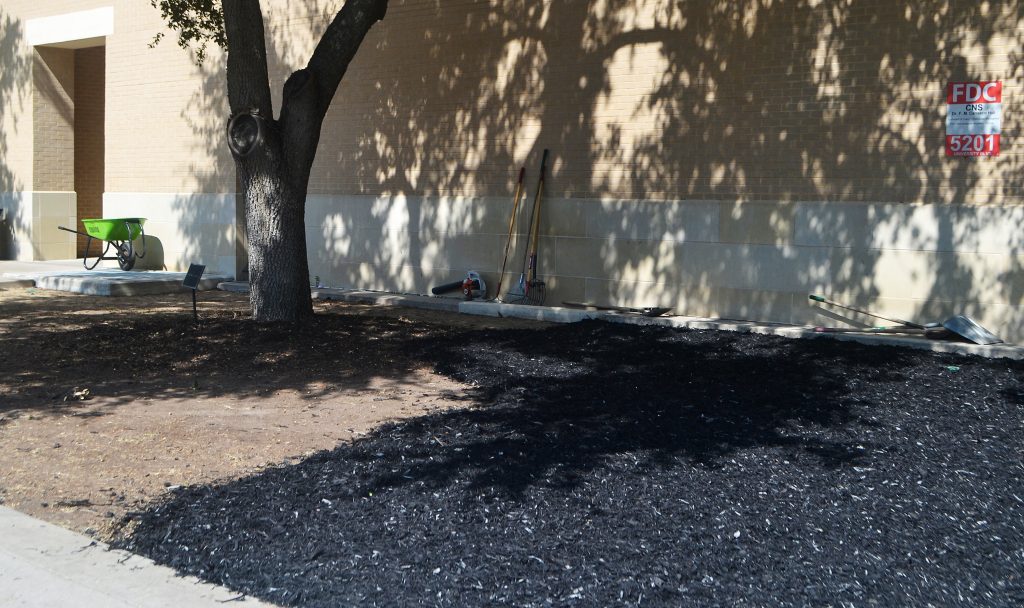
Freshly laid black-dyed mulch lines the outside patch of the Dr. F. M. Canseco Hall on Oct. 22, 2025., partyway through its installation.
This installation has not garnered as much controversy as the artificial turf, but it is still on the radar of students across campus, including TAMIU’s American Chemical Society Student Chapter.
“It has its good and bad,” TAMIU American Chemical Society President Jema Rebeles said. “It reduces chemical usage, saves water and it ensures soil health.”
Still, the mulch comes with unique drawbacks.
“It isn’t a very sustainable source.” Rebeles said.” It does contain dyes, which isn’t good if you consider the animal life that lives here on campus.
“Another thing that contributes to climate change and ozone depletion is CO2 emissions. Something as small as having real grass on campus can lower that supply of CO2 in the air.”
Alternatives could be considered.
“The only thing I would recommend is probably finding a more sustainable source,” Rebeles said. “It’s important to use eco-friendly materials.”
Rio Grande International Study Center Watershed Science Director Martin Castro holds a similar sentiment.
“There’s definitely some environmental concerns, especially in hot climates like Laredo and other areas that have a lot of wildlife like TAMIU does,” Castro said.
“There’s pros and cons to it. Mulch will help reduce evaporation; it regulates the surface temperature of the soil [and] it helps suppress weeds because they can’t really grow through that.”
Castro emphasized the potential cons of installing mulch.
“You have dye that can leach into the soil, especially if it’s not natural,” he said.
Castro shifted his focus to the wildlife on campus and the potential effects of mulch.
“There’s a lot of white-tailed deer and javelinas that call the campus their home,” he said. “I don’t think mulch has a lot of forage value for them. Some animals may ingest the mulch chips accidentally.”
Castro offered possible alternatives that could be more environmentally friendly.
“The preferred alternative would be to use natural brown mulch or mulch that’s not been dyed with artificial dyes or chemicals,” he said.
While the new black-dyed mulch has been on students’ and professionals’ minds, the sentiment remains that it is less environmentally damaging than artificial turf, but it still has unique environmental drawbacks.

