
CAMPUS: TAMIU’s turf: An examination of environmental impact
By Sean Jimenez
Associate Editor
Published Tuesday, Feb. 10, 2026
The artificial turf on campus has been in place since Fall 2024, drawing attention and controversy since its installation. So far, opinions vary.
Located where prior natural grass resided, the bright green turf now covers the medians for multiple walkways on campus, such as those between the Sue & Radcliffe Killam Library and Dr. Billy F. Cowart Hall and those near Anthony J. and Georgia A. Pellegrino and Dr. F.M. Canseco halls.
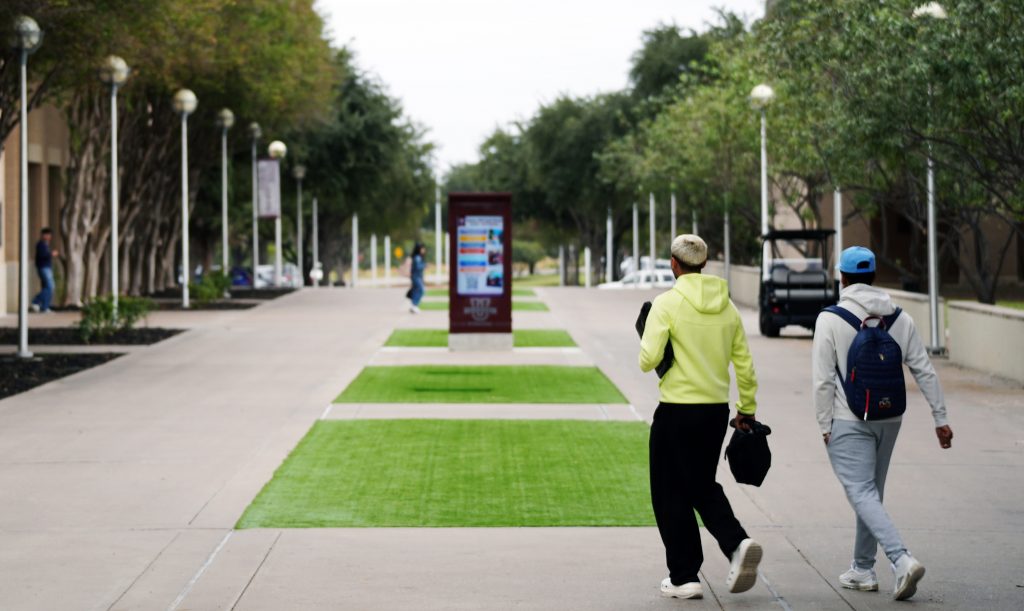
TAMIU students walk by the turf path between the Sue & Radcliffe Killam Library and Dr. Billy F. Cowart Hall on Dec 1, 2025.
Students across Texas A&M International University, such as junior biology major Paola Fuentes, voiced concern regarding the turf and its potential impact on wildlife and campus aesthetics.
“The turf feels like an eyesore compared to the natural grass,” Fuentes said. “It looks fake, especially when the rest of campus changes with the seasons and those patches stay bright green.”
Aside from aesthetic appeal, Fuentes expressed concern for TAMIU’s wildlife.
“I’m also worried about the deer and javelinas because they don’t know it’s artificial,” she said. “They’ll eat it or walk through it, and when they poop on it, it just stays there. I’d rather see TAMIU focus on native plants or real grass that actually fits our environment.”
Trevor Liddle, senior director of campus safety and planning, views the installation of the artificial turf in a different light.
According to the Landscape Guidelines of the 2023 TAMIU Campus Master Plan, which Liddle and his team follow, “Artificial turf should be limited and utilized only in site-specific situations where natural turf grass will not thrive …”
Liddle said he is very pleased with the direction the turf has taken in the past year.
“Wherever you see that synthetic turf today, [it] was originally a form of grass that had become difficult to maintain,” Liddle said.
He emphasized that the turf was placed with the intention of lowering TAMIU’s carbon footprint and water usage.
“We were able to remove almost 200 pop-up irrigation heads. Added together, those heads were using about 5,000 gallons of water a day,” he said.
Rio Grande International Study Center Watershed Science Director Martin Castro said, “Artificial turf is not going to save water in hot climates. It’s simply going to shift the water used from irrigation to cleaning and cooling. Bottom line, it’s still going to require water, sometimes a lot of it.
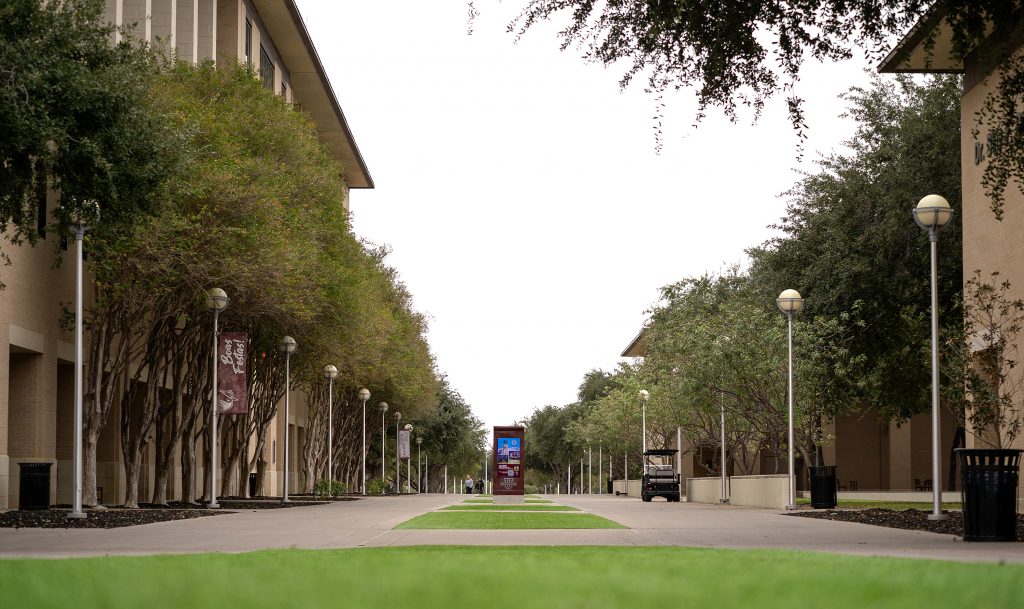
Turf patches line the walkway of TAMIU between the Sue & Radcliffe Killam Library and Dr. Billy F. Cowart Hall on Dec 1, 2025.
“In a place like Laredo, where water scarcity’s already a major challenge for us, that’s a very important consideration.”
Liddle said they installed Zoysia, a natural grass cultivated to be heat- and drought-resistant, on campus areas such as the City of Laredo Tennis Complex at TAMIU.
“Once established, Zoysia will use 50 to 75% less water than the St. Augustine here in the quad,” Liddle said. “We’re always looking at ways we can help the natural environment benefit our students.”
Castro said there is a concern for PFAS, or “forever chemicals,” in artificial turf, especially heat-resistant turf.
“As turf heats and weathers in Laredo’s very arid climate, PFAs can potentially slowly leach or shed itself into the environment,” he said.
Regarding the wildlife on campus, Liddle said, “The wildlife has largely left it alone. We have not noticed an adverse impact.”
Castro noted that a risk to wildlife and water quality is being overlooked.
“These turf systems, a lot of the time, kick up a lot of dust and, unfortunately, that’s going to include a lot of microplastics,” he said. “Once they make their way into the environment, via stormwater runoff into nearby creeks or storm drains, they’re almost impossible to remove from the environment.”
Liddle looks to the future of turf on campus.
“Will we see more synthetic grass on the campus over time? Most likely,” he suggests. “Is it going to all of a sudden take over huge swaths of lawn? We don’t envision that in these more formal lawn areas. Our goal is to keep those as grass.”
Liddle concluded by talking about TAMIU’s environmental importance in Laredo.
“We are the largest managed greenspace in Laredo and one of the greatest stewards of our natural resources,” he said. “I have the honor and privilege to steward this campus into the future to make sure it’s here for the next generation of students.”

