
EDUCATION: Nursing students rely on simulation labs to build confidence before clinical exams
By Ivana Rodriguez
Bridge contributing writer
Published Friday, March 6, 2026
Nursing students at Texas A&M International University say simulation labs give them a safe place to practice clinical judgment, build confidence, and prepare for real-world patient care.
Simulation training is one of the first hands-on experiences for nursing majors, allowing them to learn assessment and communication skills without the fear of injuring a real patient. Clinical Assistant Professor Martha Salinas said simulations help incoming students overcome early anxiety.
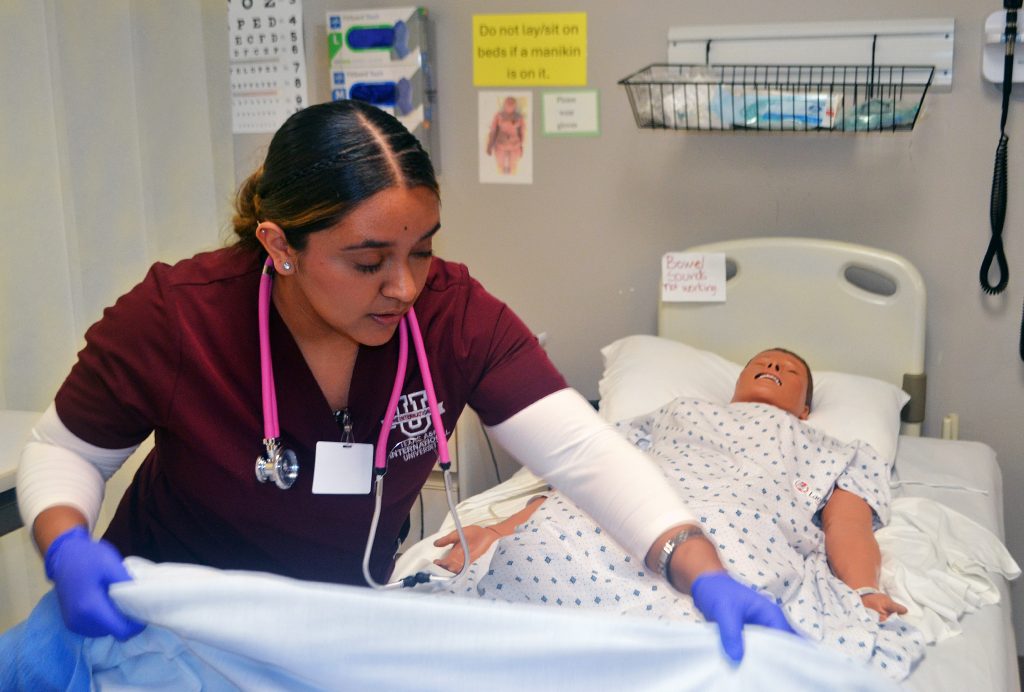
An unidentified TAMIU nursing student participates in a nursing simulation lab in the Dr. F. M. Canesco Hall on Feb. 27, 2026.
“Try to take advantage as much as possible because this is your first actual encounter with what could be a patient,” Salinas said. “You start letting go of that fear and getting more confident in what you’re asking.”
Students rotate roles—nurse, family member and assistant—while faculty guide scenarios ranging from abdominal pain to falls. Salinas said these activities push students to think critically, rather than just treating the most obvious symptom. In one scenario involving a fall, she noted many students focused on the leg injury but forgot to ask whether the patient had hit their head.
Nursing major Eliseo Rodriguez, who expected to graduate last semester, said simulations taught him to make mistakes safely before working with actual patients.
“Simulations are the safest place where you’re allowed to make mistakes,” Rodriguez said. “They debrief you on what you can improve on so you don’t make dangerous mistakes in the hospital.”
He added that simulation assignments prepare students academically and mentally for clinical hospital rotations. Each scenario requires completing homework on disease processes so students understand what to monitor and how to react if a patient’s condition changes.
“It gives us the basic foundation of what we should expect, what to look out for and how to make good judgments,” Rodriguez said.
As the program grows, some simulations now take place on weekends to accommodate more students and incorporate virtual reality exercises. Faculty say this mirrors real nursing schedules, where hospital shifts often fall on weekends and holidays.
Many agree that simulation training is essential for preparing future nurses, especially those entering the field without previous hospital experience. Rodriguez said the purpose is simple: “We just want the best for our patients. Simulations only help us get better as nurses.”

